
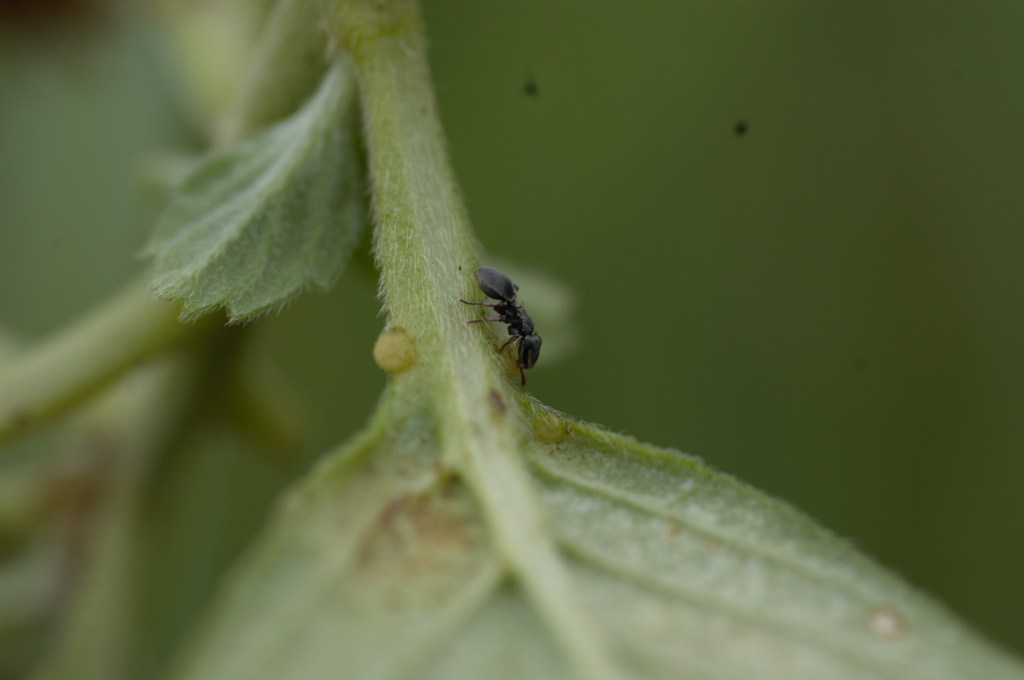
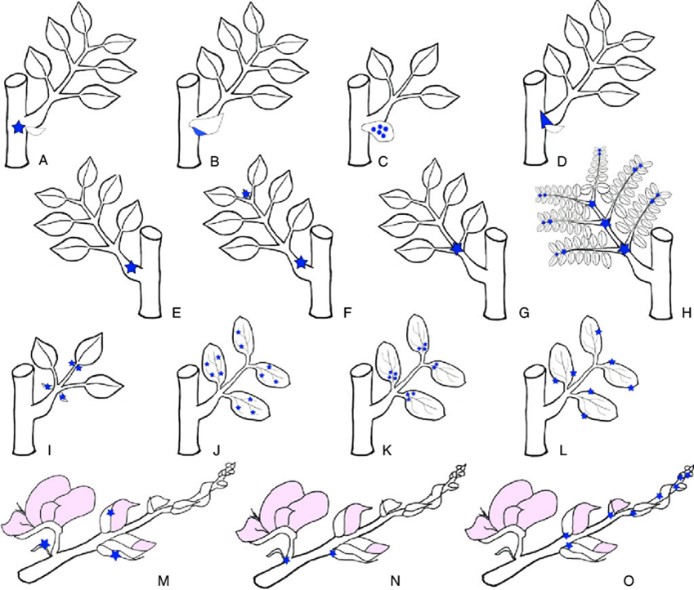
In nature, the way species interact with each other can be broken down into different categories. Mutualism is an interaction where both individuals benefit, altruism is where one individual benefits the other at their own cost, commensalism is where one species benefits without any impact to the other, and parasitism is where one individual benefits at the cost of another. Mutualisms between plants and animals often appear where the animal provides a service for the plants, such as pollination, in exchange for food, often nectar. Extrafloral nectaries (EFN) are small structures on the plants which provide a source of nectar, away from the flower where nectar is usually produced. The blue dots on Figure 2 show where they can be located on plants.
EFN are seen in a quarter of flowering plants, particularly in tropical plants. Different species of ants and plants with these EFN can have mutualistic interactions where the ant provides defence, for the plant, from herbivores, and the plant provides nectar for the ants to feed on. While this interaction may appear two sided, there has been research to suggest that the chemicals in the nectar change the ant’s behaviour to increase aggression towards herbivores.
Where does this relationship happen?
There are different factors that can influence where this relationship occurs in nature. In dry environments, the plants need to keep as much of their water as possible and therefore do not waste it on providing nectar for the ants, whereas in hot and moist environments, there is enough water available for the plants to make nectar for the ants. Environmental conditions are important for this relationship, as climate change alters the factors acting on plants in their normal habitat. Hotter and dryer climates in normally wet areas mean that the relationship may break down if the plants cannot produce enough nectar.
What’s so special about EFN?
The nectar in the EFN contains different chemicals to the floral nectar. All nectar is sweet from sugars, meaning that pollinators are more attracted to feeding from it, but the EFN nectar also contains proteins, fats and enzymes. The enzymes in the EFN keep the ant from foraging on other plants, maintaining the relationship. Invertase is an enzyme that stops the insects being able to digest sugar from the nectar of other plants. The plants are able to change the make-up of their nectar depending on which ant species live in the local habitat. Scientists have discovered that some plants even have microbes in their EFN such as fungi which produce odours that attract ants and can influence their behaviour. This suggests that nectar in the EFN is not a reward for the ants behaviour, but a manipulative signal.
What happens to the ants?
Mutualisms occur when the two individuals cannot survive without the other, known as an obligate relationship, or when the individuals are able to survive apart but do better together, a facultative relationship. Ants that defend the plants from herbivores can be either, depending on the species. When an ant and plant relationship is obligate, there is more protein in the nectar, providing a more balanced diet for the ant, whereas when the relationship is facultative, there is more sugar to entice the ants to feed there, rather than another plant. In either situation, the ants are tricked into acting aggressively towards herbivores, meaning the plant does not get eaten.
But there’s a catch…
While the ants bring benefits to the plant, there is a downside to this relationship. Ants are very bad pollinators, and they scare off the more efficient pollinators, such as bees. Even dead ants near the flowers can deter pollinating insects. Although the plants gain defence from the ants, they lose out on more effective dispersal of pollen to reproduce, therefore a balance needs to be achieved to get the best of both services.
What comes next?
In the future, it is important that scientists study how changes to the environment might influence the behaviour of the ants, and the chemicals available in the nectar, so they can predict how climate change will affect them. By understanding how different factors affect relationships in nature, such as between the ants and plants, scientists can apply that knowledge to conservation of the species.
References
Original article: Nogueira, 2026. “Ant behaviour as a mediator of extrafloral nectary-based mutualisms: interactions with nectar chemistry and environmental conditions” Ecological Entomology, 1-17 https://doi.org/10.1111/een.70065
Brown, 2023. “Symbiosis: the art of living together” National Geographic
Nogueira, 2026. “Ant behaviour as a mediator of extrafloral nectary-based mutualisms: interactions with nectar chemistry and environmental conditions” Ecological Entomology, 1-17
Marazzi et al, 2019. “Extrafloral nectaries in Leguminosae: phylogenetic distribution, morphological diversity and evolution” Australian Systematic Botany 32(6)
Novais et al, 2025. “Ants and extrafloral nectary-bearing plants” The Bulletin of the Ecological Society of America 107(1)


Leave a Reply