
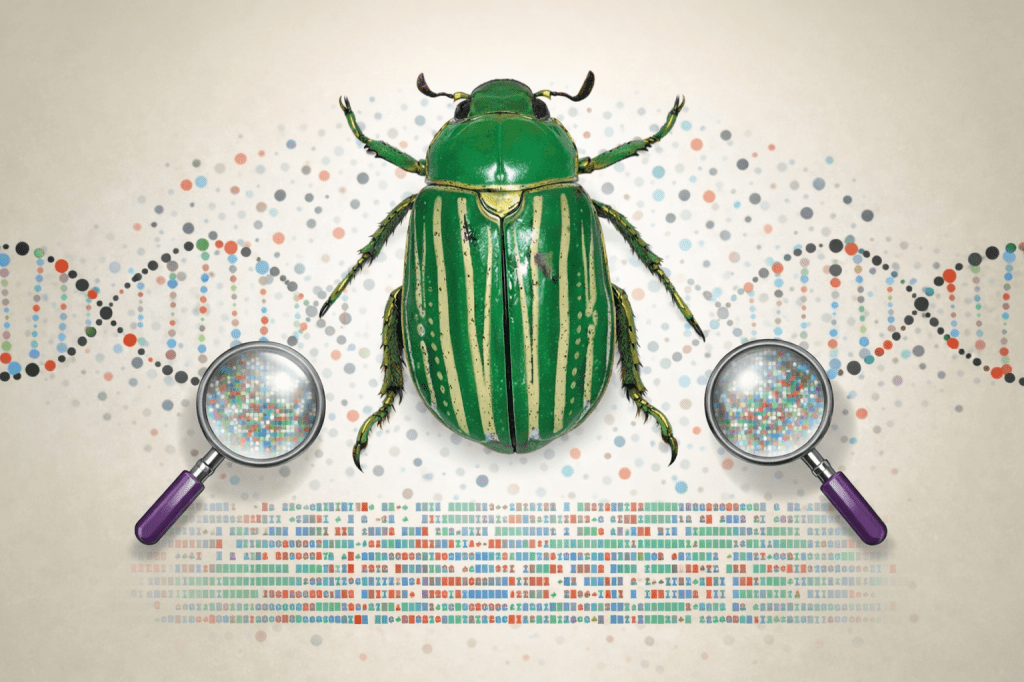
The word genomics has been flying around the scientific community for some decades, a synonym for a powerful genetic tool. Genomic tools are used to unveil the mysteries that are hidden within an organism’s genetic information, revealing what makes them the species they are. But let’s first explain what genomics is.
The genetic material of organisms is composed of four molecules called nucleotides. These are: Adenine, Thymine, Guanine and Cytosine (but if you remember them as the four letters A, T, G, C, it is completely fine). Then, genomics is the study of an organism’s complete set of genetic material (all the four letters forming part of their genetic information), examining how genes collectively shape individuals’ appearance, behaviour and adaptation to environmental conditions. This is a huge milestone in the history of genetics; we have moved from analysing a couple of genes (the Genetic Era during the 20th century), to potentially being able to identify all the genes in an organism and find the answers to many biological questions.
If you have ever wondered how an insect displays a unique characteristic, it might be explained by a particular gene or family of genes. The idea of genomics revolutionizing entomology is not an exaggeration and here are some examples of complex processes that have been deciphered through genomic tools:
- Adaptation to extreme environments with low oxygen levels or extreme temperatures (high and low).
- Feeding habit: insect species with diverse feeding habits have evolved strong digestive, detoxification, and immune systems to adapt to their dietary requirements. A mosquito feeding on blood needs a different set of genes than the omnivorous fall armyworm.
- Signal perception: insects have evolved a complex sensory system that relies on several genes, helping them decode the chemicals present in the air and in what they touch with their six legs and antennae. Their eyes are not as powerful as ours, but their antenna and legs can detect chemicals from several directions!
- Body colour determination: this plays an essential role in insect fitness, affecting mating preferences, predator avoidance, temperature regulation (and a gift for entomologists, amazed by the gigantic diversity of colours and shapes).
- Coevolution: insects evolve at the same pace as plants, parasites and other insects; in a kind of evolutionary arms race, driven by genes. Imagine a plant receives a new unwanted insect host, eating its leaves, what does the plant species do? Develops chemicals to repel the insects. What the insect will do? If you guessed developing a new strategy to digest chemicals, you have the correct answer.
Not all insects are equal (at least in genomics)
In 2011, an ambitious project, the i5k initiative, was proposed with the goal of sequencing the genomes of at least 5000 arthropods. By the end of 2025, only 2618 insect genomes had been publicly released, mainly from five groups (butterflies and moths, flies and mosquitoes, wasps and bees, beetles, and true bugs (in this hierarchical order). Many of these genomes come from agricultural pests and disease vectors. Consequently, many insect groups have remained unrepresented, or even without any plan to sequence their genomes soon, as they are not of apparent economic interest for humanity. However, one single species within an entire group might represent a “model” for the rest of the species. As a result, with some representatives per evolutionary group, there will be enough information to start answering the big questions of evolution and adaptation within each insect group.
Where does insect genomics go next?
Genomics is a data-driven scientific field. As complex as many other fields that depends on technology development, and it has been evolving quickly in the last few years. The key challenges to keep moving in the right direction are:
- Making tools more accessible to non-specialists in genomics and bioinformatics
- Encouraging open data sharing
- Defining quality standards to build new genomes and compare data among species
- Sequencing underrepresented groups, such as springtails, mayflies and caddisflies, that currently do not have any genomic information available
Insects affect agriculture, ecosystems, and human health on a global scale. Understanding their biology at the genomic level isn’t just an academic exercise, it has real world implications for better pest control strategies, advances in evolutionary biology, new drug discovery, or other applications. We are no longer just observing insects, we are decoding them, uncovering the genetic mysteries of one of the most successful groups of organisms on Earth.
Original article: Fei Li, Xianhui Wang, Xin Zhou. 2025. The Genomics Revolution Drives a New Era in Entomology. Annual Review of Entomology, 70: 379-400.
Featured Image: created by the author using ChatGPT


Leave a Reply