
The ability to associate bright colors with the threat of harm is a basic survival skill. Consider the crimson hourglass on a black widow spider or the brilliant scarlet of the fire ant, warning us to keep our distance or suffer its painful venom. This association between vivid color and danger is so intuitive that we intentionally demarcate all kinds of physical threats, from caustic chemicals to traffic intersections, with bright red warning coloration.
The instinct to connect striking pigmentation with danger extends far beyond human society, however. For example, the flamboyant orange of the monarch butterfly effectively fends off would-be predators; birds ignoring this forewarning and attempting to consume the butterfly are subject to vomiting.
In ecology, we call this bright warning coloring aposematism. And, although it’s easy to assume that toxicity causes warning coloration or vice versa, we don’t have proof of that. Plenty of animals can be plainly hued and still cause overwhelming damage, like the brown recluse spider with its necrotic venom. Yet other species may demonstrate Bayesian mimicry and flaunt bright colors without possessing a defense tactic, as the non-stinging hoverfly resembles a wasp.
Many toxic insects obtain the necessary poisonous compounds from their food. In the Lepidoptera, some longwing butterflies obtain toxic compounds from the cyanogenic passionflower plant, effectively subjecting their predators to cyanide poisoning. Other insects specializing on passionflower include some members of the Coreidae, or the leaf-footed bugs, of the Hemipteran order.
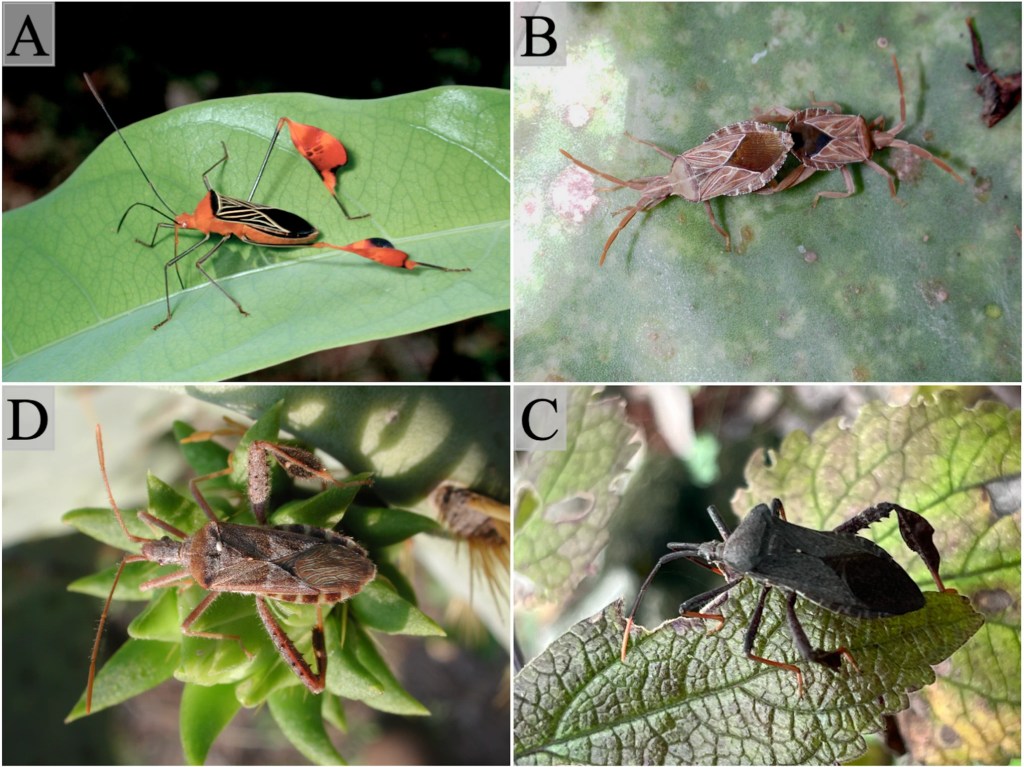
One such leaf-footed bug is Bitta alipes, commonly known as the matador bug. Vivid scarlet with literal red flags on its hind legs, the matador bug exemplifies aposematic coloration… but could it also accumulate cyanide from its passionflower diet, just like the longwing butterflies? To begin to understand the relationship between warning coloration and toxicity, the authors of this study decided to measure the cyanide content of the matador bug, as well as three non-aposematic, yet closely related, species of leaf-footed bugs feeding on plants not known to contain cyanide. They hypothesized that the matador bug would demonstrate cyanide retention, while its comparatively boring-looking cousins would not.
To quantify the cyanide content of the four species of leaf-footed bug, as well as two common host plants of the dull-looking cousins, the authors followed a previously established protocol. Bug bodies and plant samples were frozen, submerged in acid, and shaken. The resulting sludge was filtered before adding more acid, boiling, combining with a cold base, and chilling. A base, buffer, and chlorinating agent were then added, and the solution was oxidized. Finally, a reagent which changes color on detecting cyanide was added to the solution. Scientists subjected this solution to a spectrophotometer, which measures the concentration of a compound based on its ability to absorb light.
As predicted, the matador bug demonstrated notable cyanide retention—the first record of this phenomenon in the Coreidae. But, unprecedentedly, the boring-looking cousins retained more cyanide than the matador bug! Testing of two of these cousins’ common plant hosts, prickly pear cactus and yaupon holly, revealed measurable cyanide concentrations. Cactus and holly families were not previously thought to be cyanogenic, making this a major breakthrough. Evidence of cyanide in the plainly colored leaf-footed bugs indicates a chemical defense system unadvertised by aposematism.
Understanding why the matador bug visually advertises its toxicity, and why closely-related and similarly toxic species do not, may not yield a one-size-fits-all explanation. While considerable work will be required to untangle this relationship, the evidence of similar chemical defense strategies in closely-related species, regardless of aposematism, has exciting implications for future discoveries among insects and plants alike — especially considering, as the authors put it, “…the paradigm in which an organism’s palatability spectrum correlates with its degree of warning coloration is more nuanced than typically appreciated.”
Reference:
Morrison CR, Sedio BE, Gilbert LE, Havird JC, Somjee U (2026) The matador bug and several related leaf-footed bugs (Hemiptera: Coreidae) accumulate cyanogens from their host plants. Journal of Chemical Ecology 52:62. https://doi.org/10.1007/s10886-026-01730-6


Leave a Reply