
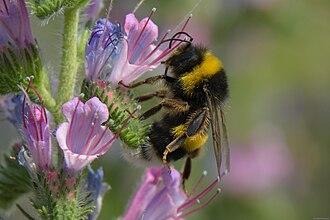
I´ve (luckily) never met a person that was not delighted when coming across a bumblebee. Fuzzy, chunky and slowly buzzing around from flower to flower – What´s not to like? In spring and summer, our fluffy friends are a common occurrence in meadows, parks, and gardens. But have you ever wondered about where the bumblebees disappear to in winter?
While all 47 bumblebee species in Europe belong to (you might´ve guessed) the bees, they spend their year decidedly different than their cousins, the honeybee.
While they also belong to the social bees but in spring, a new queen starts out pretty lonely. She emerges from her long hibernation with two goals in mind: Find food and find a nest. By indulging in the nectar of spring flowers, she gains enough energy to look for a new home. For instance, this might be an abandoned mouse hole, or she nests in long tangled grass, depending on the species. If you keep your eyes open in spring, usually between late March and May, you will see the massive queens hovering close to the ground inspecting nature´s real estate market.
Once settled in, she collects and stores more nectar and now also pollen. This is not only the thing you might be allergic to but is important for plant pollination and for the bumblebee, it serves as protein source. On a little clump of pollen mixed with nectar, the queen will now start laying eggs that resemble tiny pale-white sausages. To help her eggs develop, the queen will breed them by sitting on top of them to make it warm and cozy – similar to a chicken in a coop! During this time, the queen will keep her foraging trips short and focuses on breeding and has some nectar storage tucked away for bad-weather days.
After a few days, the eggs will hatch and larvae emerge. Living in corresponding cups, they feed on pollen provided by the queen, grow, moult, eat, grow, moult (rinse and repeat) for roughly 10 to 14 days. Similar to butterflies, the next step is pupation: The larvae spin a silk cocoon around themselves and go through metamorphosis. This is the process in which the body totally transforms and instead of a maggot-like larva, a bumblebee worker with legs, wings, and antennae emerges.
Finally, the queen is not alone anymore! She stops leaving the nest and keeps laying eggs while her daughters take over the task of collecting nectar and pollen for the colony and support her at breeding. Now you can also see workers flying around: They are not as massive as their mother and also don´t live as long; usually a worker bumblebee only lives for a few weeks.
The colony keeps growing now, with workers bringing in food, the queen laying eggs and everyone breeding the offspring. In summer, colonies of some species can grow to hundreds of bumblebees!
At one point, the queen stops producing workers and switches to producing new queens and males. In contrast to workers and queens, males develop from unfertilized eggs. New queens (also called gynes) feed on way more pollen during their development than worker larvae and grow much bigger than their sisters. Both males and gynes leave the nest after their development, but importantly the gynes try to eat as much as possible before finally departing. The more fat they can store, the higher their chances of getting through winter! Once outside the nest, gynes mate with males from other colonies.
While the remaining old colony declines, the new queens go searching for a safe spot to sleep through winter. Next year, it´s their turn to found a new colony and for that they need all the strength they can get.
Sources:


Leave a Reply