
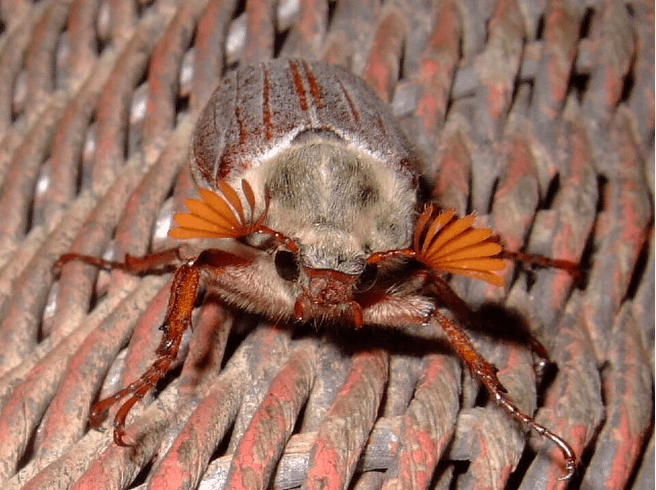
If you’ve ever paused to think about insect names, you’ll quickly notice how strange they can be. By combining entomology (the study of insects) with etymology (the study of word origins), we can uncover the fascinating stories behind them.
The cockchafer is a particularly good example: its name has ancient linguistic roots, while its history includes nineteenth-century scientific debates and even a childhood experiment by Nikola Tesla.
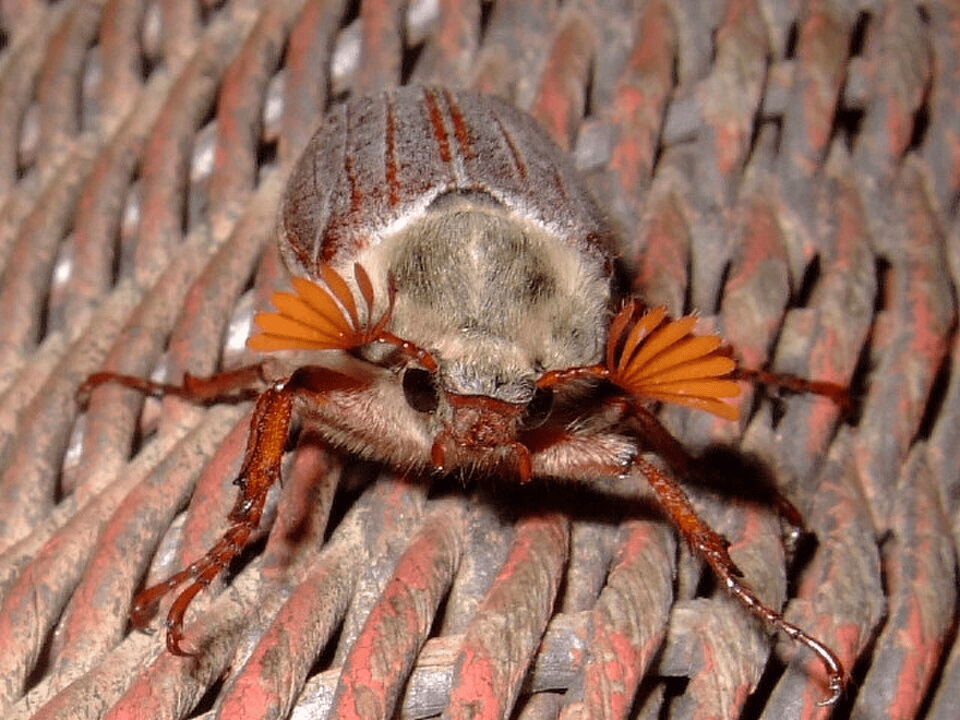
A male cockchafer, showing the seven “leaves” on the antennae. (Public domain)
So Where Did the Name Come From?
At first glance, the name “cockchafer” sounds rather peculiar. It combines two familiar words, but neither gives a particularly clear description of the insect.
The word “chafer” has some of the deepest roots in the name. Old English ceafor was a general term for a beetle, while related Germanic words were also used for beetles more broadly. The term was therefore not originally exclusive to the insects we now call chafers.
The addition of “cock” is less certain. Historical etymological sources generally connect it with the beetle’s large size or vigour. The combined word “cockchafer” has been recorded in English since at least the seventeenth century.
Cockchafers have also acquired a surprising collection of regional names. Alongside May bug, they have been known as Bummler, Humbuz, Kittywitch, and my personal favourite, Snartlegog. These names reflect the variety of local traditions and descriptions that have surrounded the beetle over time.
Cockchafers or Cock-chasers?
Perhaps the strangest chapter in the cockchafer’s history began in 1834. European naturalists reported an unusual behaviour, coupling between two male cockchafers. Rather than simply accepting the observation, naturalists debated how such behaviour should be understood.
Reports of male–male coupling in cockchafers continued to appear throughout the nineteenth century. Naturalists attempted to explain the behaviour using the scientific ideas of their time, and their responses reveal how strongly contemporary attitudes towards sexuality influenced the interpretation of “normal” animal behaviour.
The insects themselves, of course, had no interest in the controversy. Their behaviour simply provided an observation that challenged the assumptions of the people studying them.
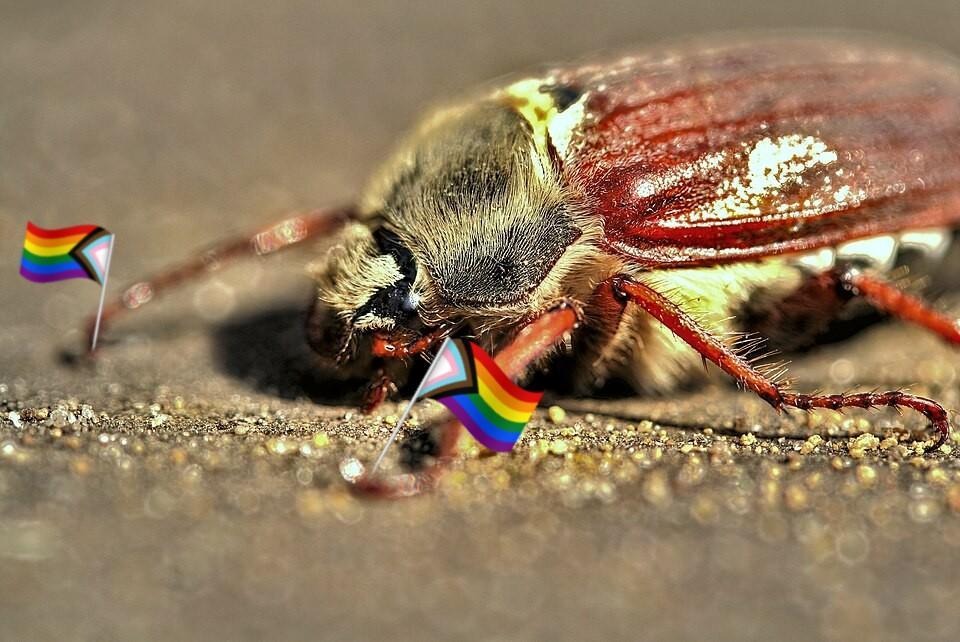
Melolontha melolontha (Public Domain) (pride flags added by me)
The Cockchafer and Nikola Tesla
The cockchafer also has an unexpected connection to one of history’s most famous inventors: Nikola Tesla.
In his autobiography, Tesla recalled an experiment from his childhood in which he used four “May-bugs” to create a simple mechanical device. He attached the insects to a crosspiece mounted on a spindle, allowing their movements to rotate a larger disc. Tesla recalled that the insects continued turning the mechanism for hours, particularly in warm conditions.
For Tesla, the experiment was an early attempt to harness natural energy for a practical purpose. The experiment eventually came to an end when another boy ate one of the beetles alive, an experience Tesla described as so unpleasant that he claimed he never wanted to touch a “May-bug” or any other insect again.
When Language Meets Science
The story of the cockchafer shows how much can be hidden behind a common name. “Cockchafer” preserves an old word for beetle, while names such as May-bug, Bummler, Humbuz, Kittywitch and Snartlegog reflect the different ways people have described the same insect across time and place.
Its history goes beyond language, too. The cockchafer became part of nineteenth-century debates about animal behaviour and became the unlikely power source for one of Nikola Tesla’s childhood experiments.
Common names may not follow the rules of scientific classification, but that is part of what makes them interesting. They preserve fragments of language, culture, and history, giving familiar insects stories that go far beyond their scientific names.
References
- Brooks, R. (2009). All too human: responses to same-sex copulation in the common cockchafer (Melolontha melolontha (L.)), 1834–1900. Archives of Natural History, 36(1), 146–159. https://doi.org/10.3366/E0260954108000703
- Tesla, N. (1919). My inventions. Electrical Experimenter, 5–7.
- Online Etymology Dictionary. Cockchafer; Chafer.
- Oxford English Dictionary. Cockchafer, n. Oxford University Press


Leave a Reply