
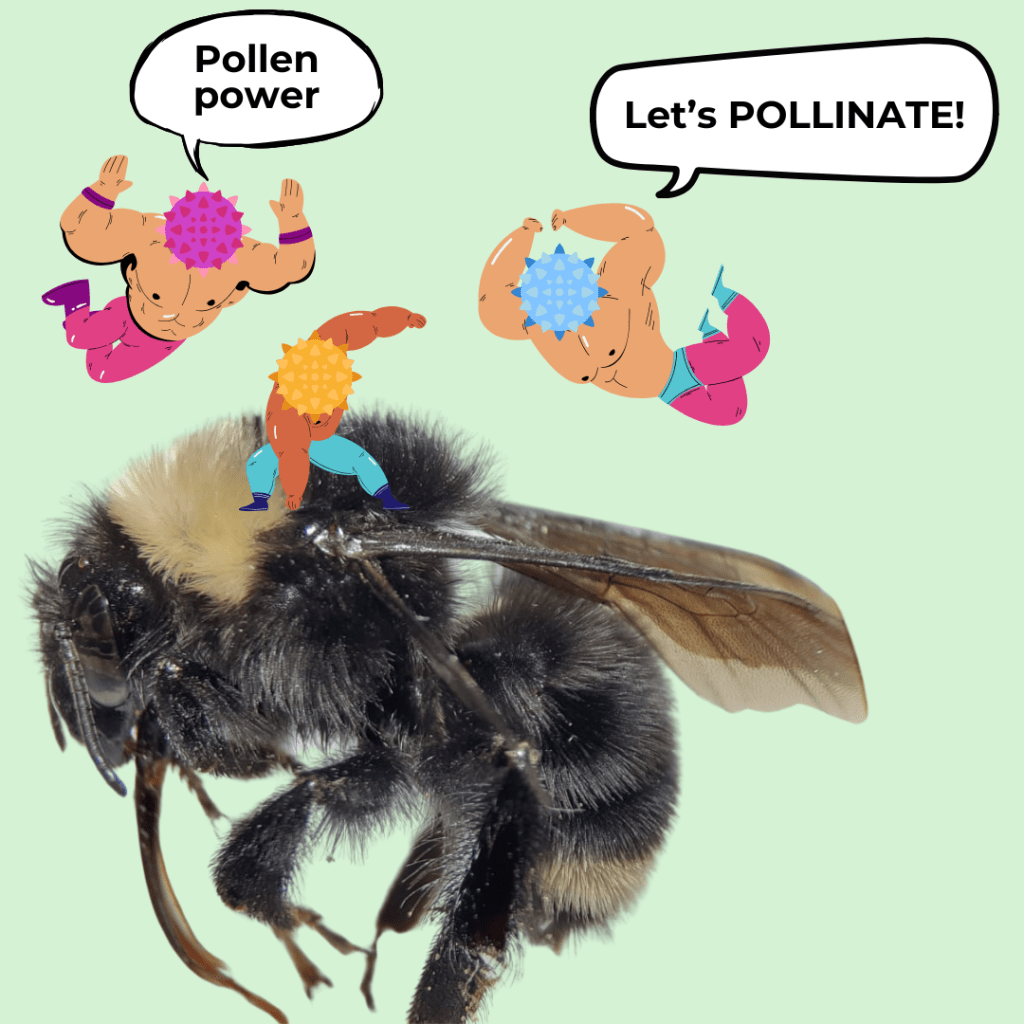
Imagine you’re a tiny grain of pollen riding on the back of a bumblebee. Your mission is to reach another flower so you can help complete the process of pollination. You’re not alone, about 500 other pollen grains are traveling right beside you, and all of you are competing to reach the flower first. How can you make sure you get there before the others? You’ll have to compete.
This study reveals an often-ignored aspect of pollination: the competition happening among pollen grains on the bodies of insects. This is an essential step in pollination, yet it’s rarely mentioned in school. Just imagine, whoever wins this microscopic battle will help its plant reproduce.
How did researchers investigate this hidden stage of pollination?
In this study, the authors wanted to know whether bees and flies transport pollen in the same way. Does the amount of pollen change depending on the insect? And how many pollen grains hitch a ride on each kind of pollinator?
Specifically, they compared the pollen loads of bumblebees, honeybees, megachilid bees, other bee species, and even bee-mimicking flies (bee flies). These groups differ in their sizes and in how they collect pollen. The researchers also compared males and females. In bees, females visit flowers frequently to collect nectar and pollen to feed their offspring. You could say they’re doing the grocery shopping. Males also visit flowers, but for different reasons: eating, resting, and looking for mates.
To answer these questions, the researchers collected insects in northern California using entomological nets. Then they removed the pollen from their bodies using a pink gelatin. This is a kind of like a soft piece of sticky tape that lifts the pollen off without harming the insect. Under the microscope, they counted and identified which plant each grain came from. In the end, they counted 263,394 pollen grains from 40 plant species, carried by 733 insects. Crazy, right?
With this information, they determined what type of pollen and how much of it each insect carried. Then they constructed co-transport networks, which is basically a map showing which pollen species tend to travel together and how often. It’s like having access to your subway travel history and being able to see which passengers ride the same routes as you.
So what did these maps reveal about pollinators?
The researchers discovered that not all pollinators carry the same type of pollen load or the same mixture of pollen species. Bumblebees carry more pollen and a more diverse mix compared to other insects. Megachilid bees, like leafcutter and mason bees, carry much more complex mixes. Bee flies carry fewer types of pollen, but they are still effective pollinators. That is, a bumblebee is like a school bus full of students, while a Megachilidae bee is more like a bus carrying passengers headed to very different destinations: work, a party, school, anywhere. And a fly? It’s more like a taxi carrying just a few passengers on a direct trip.
Does size or sex make a difference in this pollen transport?
Another important finding was the role of size: larger bees transported more pollen and a greater variety of species. This was the case for bumblebees. Females carried twice as much pollen as males, probably because they visit more often flowers, and are “packed” with food for their offspring. Males, on the other hand, carried more varied pollen loads.
What happens to pollen grains once they are riding on a pollinator?
They also found that a pollen grain might travel with others of its own species or with pollen from up to 15 different plant species, depending on the insect. The more species packed onto each insect body, the lower the chances of successfully pollinating a flower. Imagine competing with 15 classmates for the best seat on the bus. It’d be a lot easier with fewer competitors, right?
Plant pollination doesn’t depend only on pollinators visiting flowers. It also depends on a series of stages that gradually reduce the chances of pollen reaching its final destination. This study reveals one more step in the process: what happens while pollen is riding on bees and flies. It also highlights the importance of the driver for those pollen grains. Depending on who does the transporting, the level of competition may intensify or relax. A pollinator that allows many different pollen species to stick to its body will host a more epic battle.
What about the pollinator that usually gets most of the credit?
The study also examined honeybee pollen loads. Honeybees often steal the spotlight as the most important pollinators. But this research shows that other insects, like bumblebees and even bee flies, play a very important role in transporting pollen in these ecosystems. Finally, the researchers note that climate change can affect insect size and behavior, with smaller bees appearing at higher temperatures. This matters because it could influence pollination and, ultimately, plant reproduction.
So what can we conclude from all this?
In conclusion, the researchers found that bees and flies do not transport pollen in the same way. They differ in the quantity and identity of the pollen they carry. The study also proposes that insect bodies act as tiny combat arenas, where silent battles take place with the wonderful purpose of helping plants reproduce. Nature is full of small, hidden stories. You just have to know where to look.
Reference: Carneiro, L. T., Williams, J. N., Barker, D. A., Anderson, J. W., Martel, C., & Arceo-Gomez, G. (2024). Patterns and drivers of pollen co-transport network structure vary across pollinator functional groups. Journal of Ecology, 112, 2319–2332. https://doi.org/10.1111/1365-2745.14397
 EntoBites
Leave a comment