
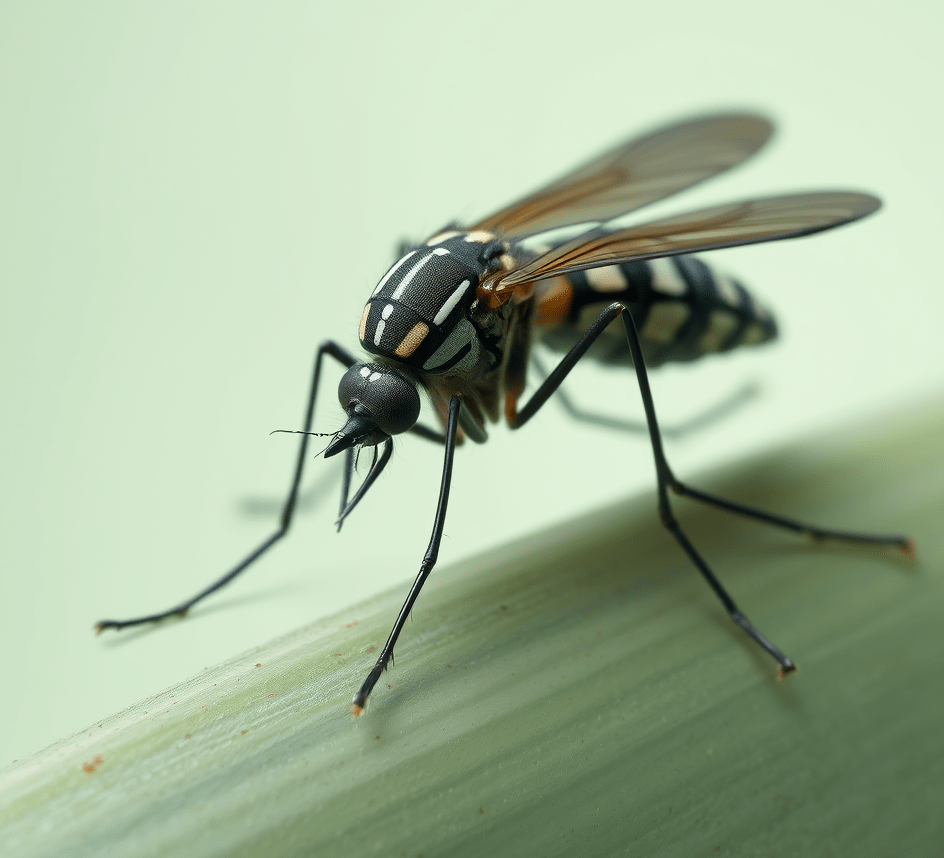
Did you know that the mosquito Aedes aegypti isn’t just annoying but is also a serious health risk?
This little flying insect is the main vector for diseases like dengue, Zika, and yellow fever, making it an important target for pest control. Unfortunately, conventional mosquito control, such as spraying insecticides, has been less effective lately. Why? Resistance! Mosquitoes are becoming resistant to the chemicals, which forces researchers to uncover other options.
What could be the solution for this unpleasant situation?
The answer might probably be found in nature itself. More specifically, in seaweed. In this study from 2025, scientists were interested in two types of seaweed: brown seaweed (Sargassum vulgare), a species of brown algae common in the Atlantic Ocean, and sea grapes (Caulerpa racemosa), a species of edible green alga commonly found in South-East Asia. Scientists were interested to see if these algae could be used for controlling mosquitoes without harmful side effects on the environment and humans. So, could these marine organisms be the next big thing in mosquito control?
These scientists didn’t just guess. They investigated the seaweed’s chemical composition and found a whole bunch of bioactive compounds like alkaloids, terpenes, and fatty acids, which are known to have insecticidal properties.
But will these chemicals work in practice?
After testing the seaweed extracts on mosquito larvae, the researchers discovered that, yes, they have a lethal effect. In fact, exposure to Sargassum vulgare extracts killed 95% of the mosquito larvae within 48 hours, and Caulerpa racemosa extracts showed promising results too. However, the larvae were dying one by one rather than instantly, suggesting that these compounds work gradually and steadily. Could this slow action be an advantage in controlling mosquito populations over time?
The researchers didn’t stop there; they also looked at what happens to the larvae on a molecular level. They examined how the seaweed extracts affected the mosquitoes’ biology, and the results were fascinating. Individuals exposed to both extracts showed changes in their external features, such as a loss of bristles and gill filaments, both crucial for the larvae’s survival. They also measured an increase in certain enzymes, suggesting that the seaweed extracts were causing an imbalance in the larvae’s body processes.
What’s the bigger picture here?
These findings show that marine algae could be a viable, eco-friendly alternative to chemical insecticides. No harmful effects on human cells were observed, so it’s a win for both us and the environment (unfortunately, not for the mosquitoes)!
So, could seaweed become the next tool in our fight against mosquito-borne diseases? There is potential, but more studies are indeed needed. Still, it’s an exciting step in the search for natural, effective pest control solutions.
Reference: Xavier KCM, do Nascimento Santos DKD, da Cruz RCD, da Silva LQM, Araújo AMS, Dos Santos PÉM, Guedes PM, Rolim LA, Bedor DCG, Júnior SA. Insecticidal effects of Sargassum vulgare and Caulerpa racemosa extracts on Aedes aegypti. Parasitol Int. 2025 Jun;106:103031. doi: 10.1016/j.parint.2025.103031. Epub 2025 Jan 13. PMID: 39814260.


Leave a Reply