
Original article: https://besjournals.onlinelibrary.wiley.com/doi/full/10.1111/1365-2745.14446
When we think of pollination, we picture a beneficial relationship between plant and pollinator: one gains sweet nectar and protein-rich pollen, the other can reproduce and spread their population. Everyone’s happy. But it isn’t always this straightforward: the world of pollination is full of tricksters. Many plants can deceive pollinators into spreading their pollen without a reward, by pretending to be another resource the insect needs, such as a site to lay eggs, a food source, or even a mate (Gaskett, 2011 ). Think of the corpse flower (Kite and Hetterschieid, 1997), reeking of rotten flesh, with its meat-like textured surface, luring flies to what they think is the perfect oviposition (egg-laying) site. When the fly arrives, there is no rotting meat to be found, but they leave with a dusting of pollen, ready to deposit on the next corpse flower. Here, we will explore a new example of floral mimicry and deception, recently discovered in Australia.
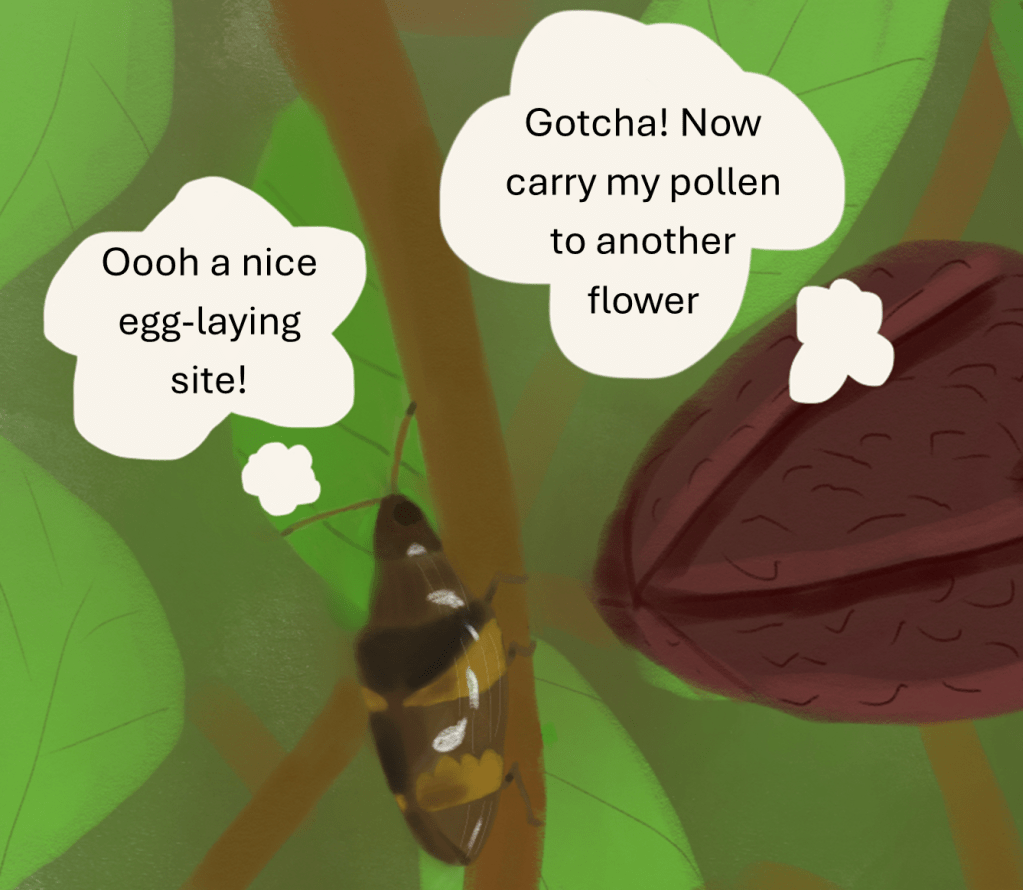
We are entering the coastal notophyll forests of Queensland. Caught in the branches of scrubs and trees, you notice clumps of decaying material. This ‘aerial litter’, made up of dead leaves clinging onto plants, or fallen leaves caught in branches and twigs, is an important habitat for many different species, including fungi, spiders, spring-tails, and beetles. Loberus sharpi is one these beetles, using the aerial litter for shelter and oviposition. However, not all these decaying, leafy clumps are what they seem.
A small understory tree, Meiogyne heteropetala, is taking advantage of the beetles’ use of aerial litter. The flowers, deep maroon and roughly textured, look just like surrounding litter. They even smell like it. But the beetle eggs and hatched larvae don’t last long on the flowers, as the petals eventually fall to the forest floor. Meanwhile, the beetle, sprinkled with pollen, goes on to visit another leafy-smelling flower…
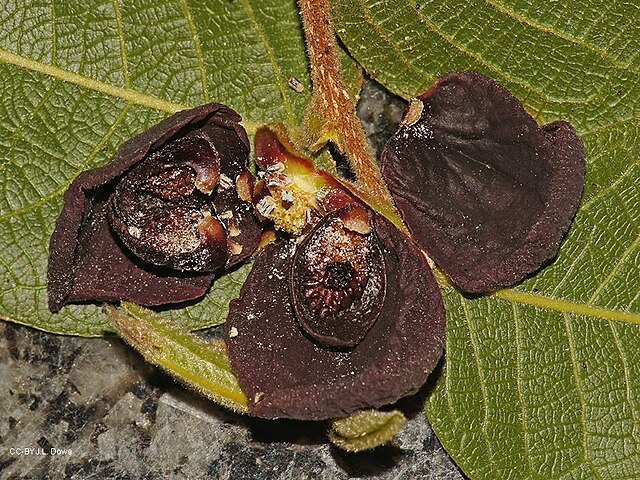
Picture: Dissected Meiogyne heteropetala flower (J.L. Dowe, Wikimedia Commons)
This floral deception was discovered by researchers at the University of Hong Kong. Visiting the notophyll forests over five years, they aimed to discover the most effective pollinators of M. heteropetala, to test whether the flower mimics aerial litter through visual and olfactory (scent) traits, and to study the beetles’ response to the floral scent.
Identifying the pollinators
The researchers collected the insects that visited M. heteropetala flowers, and identified which were likely pollinators: to qualify, the insects needed to visit during both sexual phases (M. heteropetala flowers go through a female phase, during which the stigma is receptive to pollen, and a male phase, where the anthers release pollen) and must be able to access the inner floral chamber (enclosed within the petals). Insects also needed to be coated in M. heteropetala pollen grains when visiting flowers during the female phase. From this, the beetle L. sharpi was identified as the most likely effective pollinator, and the researchers observed its behaviour and checked for eggs and larvae on the flowers.
Flower visual traits
To test whether the M. heteropetala flowers visually resemble aerial litter, the researchers measured the size and spectral reflectance (a way of quantifying colour based on the wavelengths of light a surface reflects) of the flower petals and litter. Although there was much higher variation in the size and spectral reflectance of the litter compared to flowers, unsurprising as the clumps of leaves are from lots of different plant species, the flowers fell within the range of values for litter.
Flower scent
Flowers create scent by releasing simple volatile organic compounds (VOCs) into the air; insect pollinators can then detect and respond to these chemicals. Plant species often release different compound mixtures, creating unique scents and potentially attracting different pollinators. The researchers collected scent by enclosing flowers and aerial litter in ‘headspace’ bags, into which the VOCs are released and captured. Gas chromatography-mass spectrometry (GC-MS) was used to analyse the scents. This technique separates out the molecules in a scent mixture, allowing them to be identified.
Similarly to the visual traits, there was much higher variation in aerial litter VOC composition compared to the flowers. However, the floral scent still resembled the dead leaves, with 99% of floral volatiles also found in the litter.
Beetle behaviour
The researchers tested whether L. sharpi beetles preferred the odour of aerial litter or the mimicking flowers, by presenting them with choices of the scents in a Y-shaped chamber, and noting which arm of the ‘Y’ the beetle chose. Although the beetles selected the flower scent over an air control, they still preferred leaf litter over the flowers, indicating that the scent mimicry is not perfect.
Conclusions
The discovery of the similarity in scent and visual traits between M. heteropetala flowers and aerial litter suggests that the tree is indeed deceiving L. sharpi into pollinating it, with a cost to beetle reproduction. The mimicry is clearly not exact, as beetles can distinguish between the flowers and litter, but enough are deceived to pollinate the plant. This is the first time that floral mimicry of aerial litter has been reported, and the researchers have already found another potential mimic, so watch this space! The novel discovery of mimicry of a substance as common as decaying leaves caught in trees, highlights just how much there is still to learn in the world of chemical ecology.
References
Gaskett, A.C., 2011. Orchid pollination by sexual deception: pollinator perspectives. Biological Reviews, 86(1), pp. 33-75.
Kite, G.C. & Hetterschieid, W.L.A., 1997. Inflorescence odours of Amorphophallus and Pseudodracontium (Araceae), Phytochemistry, 46(1), pp. 71-75.
 EntoBites
Leave a comment