
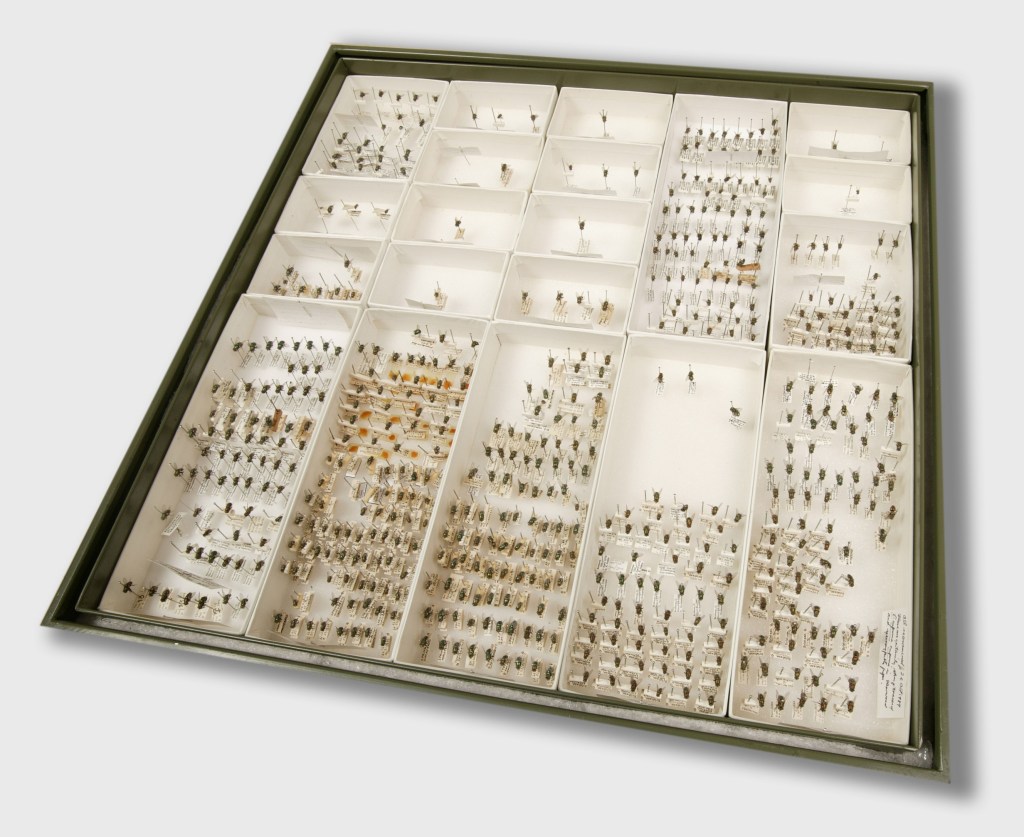
Figure: A tray of pinned blow flies from the Australian National Insect Collection at CSIRO Entomology (2006), by David McClenaghan, CSIRO ScienceImage, licensed under CC BY 3.0 (https://creativecommons.org/licenses/by/3.0/).
Imagine that you have been having a lot of fun collecting insects for months for an exciting entomological project, and you end up with dozens of samples, each one with hundreds or even thousands of insects. You feel ready, have a lot of fun scanning the first sample and are amazed by the wonderful diversity of insects, but when you try to identify the first insect you discover it is quite complicated, so you skip this one for “latter”. Let’s pick another one, same story. After some weeks, reading a lot of specialized information, and some support from experts, you might be closer to identifying a few dozens of insects. So, you will succeed identifying part of the samples you collected, but what happened to the other thousands of insects waiting in the collection jars?
What is entomological dark taxa?
Those samples potentially will end up stored on shelves for decades, and they might fall into the term “insect dark matter” or “dark taxa”. The term was proposed by Page (2011), and refers to all unidentified genetic information added to GenBank that aren’t related to a known species; then the term has been also used for unidentified specimens in collections and stored samples. This is quite crucial, as this might represent undescribed new species to science, but also might represent insects that have already been described, but without a matching taxonomic and genetic information to identify it by genetic means.
A barcode for every insect?
A huge idea emerged during the middle of the XX century to address this important issue. Utilizing the newly developed PCR reaction: it was proposed to standardize the amplification of a known DNA chunk present in every living organism and use it as a barcode, thinking that after a lot of effort, it would be as simple as using the barcodes you use every day in the supermarket. It was a brilliant idea: if two insects share the same barcode, they are likely the same species. Today, global databases hold over 15 million insect DNA barcodes representing thousands of species. However, some insect’s taxonomists initially doubted that quite a complex task of assigning or describing a new species, could be resolved that simple (and they were somewhat right, managing such an amount of information has been a complex task). The best scenario is to match both approaches, and build, step by step, a reliable database with a physical specimen kept in a collection, with genetic and ecological information, for the coming generation to use.
From microscopes to machines
Traditionally, species discovery meant experts sorting insects one by one under microscopes, a beautiful process that will open your eyes to the wonderful colours and shapes that many insect orders display. However, this is a slow, expensive, and time-consuming process that depends almost entirely on the expertise of specialists in particular insect groups, sometimes even a single group out of the hundreds that exist.
It is quite long and might be difficult for non-entomologists to understand. Barcoding represents a reverse approach, allowing scientists to process thousands of samples, extracting DNA and hopefully matching them with a known species. Imagine doing this for all the samples you collected and just in a matter of weeks.
I hope it will be that simple, as this is still a work in progress, but many people are doing their best to accomplish this complex task. This process used to be quite expensive; however, newer sequencing technologies are bridging the gap, and insect sequences have been growing in databases in the last few decades. Barcoding and taxonomy are also training the next generation tool: artificial intelligence. High-quality images linked to DNA-identified insects are used to teach deep-learning algorithms how to recognize species automatically (although the AI has lots to learn, with over one million species described to date!).
In the future, common species may be identified from photos and DNA barcoding focuses on the rare, cryptic and unknown. The technology is ready. What is needed now is investment and collaboration.
A global effort, still uneven
There is a catch. DNA barcoding has not replaced traditional taxonomy and certainly never will, but it is already transforming how we discover, monitor, and understand insect biodiversity. Most barcoded insects come from Europe and North America, while the most biodiverse regions, especially the tropics, remain under-sampled. Collaboration is essential to accomplish the task, in a time of rapid environmental change, barcodes have been used to do something extraordinary: making the invisible visible before it’s too late.
References:
Original article: Rudolf Meier, Mara K.N. Lawniczak, Amrita Srivathsan. 2025. Illuminating Entomological Dark Matter with DNA Barcodes in an Era of Insect Decline, Deep Learning, and Genomics. Annual Review Entomology. 70:185-204. https://doi.org/10.1146/annurev-ento-040124-014001
Page, R. 2011. Dark taxa: GenBank in a post-taxonomic world. https://doi.org/10.59350/xhvv2-xjt24
 EntoBites
Leave a comment