
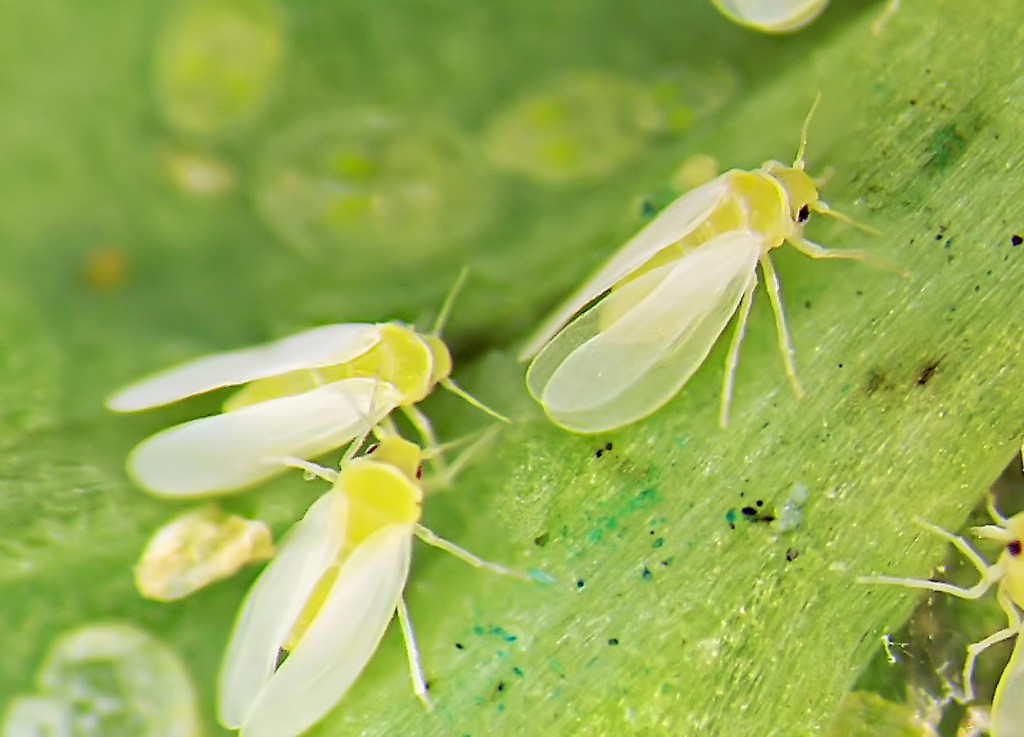
Aphids and Whiteflies are serious crop pests
The Green Peach aphid Myzus persicae along with the sweet potato whitefly Bemisia tabaci are hemipteran sap feeding crop pests. Infestations of both insects result in the loss of thousands of food plants annually, worldwide. Chemical pesticides, which can be thought of as medicines against pest insects are commonly used to treat these destructive pests. However, many pesticides are becoming less effective as pests develop resistance to them over time. For this reason, it is essential to develop new approaches to control crop pests.
Implementing Molecular biology and Biotechnology against insect pests
All organisms are made up of proteins which are encoded by the organisms’ own blueprint called DNA. This DNA makes RNA which is then used to make proteins. Each protein is made from its own special RNA molecule. RNA interference (RNAi) is a technology designed to disrupt the production of specific RNA molecules which in turn prevents the organism making one specific protein. The loss of crucial proteins results in the death of the insect. These RNAi molecules can be introduced into crop plants so that when insects feed on the plant the RNAi molecule is taken up. Plants expressing RNAi molecules have successfully been used to reduce protein expression in both aphids and whiteflies under laboratory conditions. This offers a new and exciting strategy to control crop pests.
What are horizontally transferred genes (HTG)?
HTG are those which have been picked up from bacteria, fungi, or plants in the ancestors of current insect species including Myzus persicae and Bemisia tabaci.
How can HTG be applied to biotechnology in pest control?
Before crop plants expressing RNAi can be used in the field, they must be assessed for any negative effects on beneficial insects. Beneficial insects include pollinators like bees and ants or insects that feed on pest species like ladybirds. However, many proteins essential for survival in pest insects are well conserved across insects meaning that RNAi could have negative impacts on both pests and beneficial insects. On the other hand, the proteins encoded by horizontally transferred genes (HTG) have been acquired individually in each insect lineage therefore making these proteins species specific whilst also being essential for survival. This means that the proteins encoded by HTG could potentially be incredible targets for RNAi.
Could this be a way to successfully control aphids and whiteflies in the field?
The researchers begun by identifying the proteins encoded by HTG in Myzus persicae and Bemisia tabaci from bacterial, fungal and plant origin. Nicotiana plants, which are similar to tobacco plants, were then created which expressed RNAi against these proteins encoded by HTGs.
Aphids were then fed on either RNAi expressing plants or normal nicotiana plants. The research group found that RNAi against proteins of bacterial or plant origin reduced aphid survival but did not alter reproduction when compared to normal nicotiana plants whereas HTG of fungal origin did not alter aphid survival but did reduce reproduction. Similarly, whiteflies fed on plants expressing RNAi against proteins of bacterial or fungal origin showed a reduced survival compared to normal nicotiana plants.
Do the RNAi expressing plants negatively impact the beneficial ladybug?
Ladybirds were fed on the aphids which had been exposed to either aphids fed on RNAi expressing plants or on aphids fed on regular plants. There was no significant reduction in ladybird survival when fed on the aphids exposed to RNAi plants compared to aphids on normal plants. This indicates that ladybirds are not impacted by the RNAi compounds.
What does this mean for the future?
Crop plants expressing RNAi against proteins encoded by HTG could provide a new and exciting way to target crop pests without inducing negative off-target effects in beneficial insects. However future work to evaluate the risks of RNAi expressing plants in other beneficial organisms which interact with the plant species like bumblebees should be investigated.
Original article: Horizontally transferred genes as RNA interference targets for aphid and whitefly control
 EntoBites
Leave a comment